When writing my upcoming Gothic mystery, Salome, I was a bit worried about venturing into well-trodden territory. Vampires, or Vampyres, as they are written in the book.
Salome came out of nowhere. I was actually writing the long-awaited Muldoon III (don’t worry, it’s still on schedule for 2027) and I realised… I can’t write this one without establishing the lore. I wrote Salome to tell myself the story of how everything works in this supernatural version of 19th century Europe.
While Salome isn’t strictly a vampire novel, they feature heavily.
Writing vampires was actually quite intimidating, as the vampire is such a well known character. Sometimes they’re a metaphor for something else, and other times, they really are just a vampire. You have to ask yourself some questions:
What is a vampire in your world?
Are they ruthless, soulless creatures? Are they some sort of tormented creature like Louis in Interview With The Vampire or Angel in Buffy? Do they hang around in the forest and keep going to school every year for 100 years like Edward Cullen? Do they sparkle in the sun or are they always hideous? There is so much to consider when you’re writing the vampire for the first time.
I prefer my vampires to be monstrous monsters. Saying that, I’m not against a complex vampire at all, I just prefer and enjoy writing them as soulless or compromised, heartless creatures. There is something appealing in their villainous cruelty, and I enjoy exploring that.
If you’ve read The Ring you may have noticed that I touched on vampirism. I won’t spoil it for anyone who hasn’t yet read it but that was my first attempt at bringing this classic horror creature into Muldoon’s world. I had a choice when I wrote The Spider: Let the humans do all the evil or leave some to the monsters? The supernatural elements in the Muldoon thrillers were too appealing to leave alone, so we have the supernatural taking the lead.
Writing Salome was actually the result of researching vampires and what’s already out there in terms of lore. I can’t even begin to think how many vampire novels I’ve read over the years. I’ve read plenty! So why was I so hesitant to write my own?
Because the vampire has been done before, so many times.
But not by me, and I certainly haven’t seen it played out like it is in Salome. In one of the early chapters, Father John explains to Salome what the vampire is:
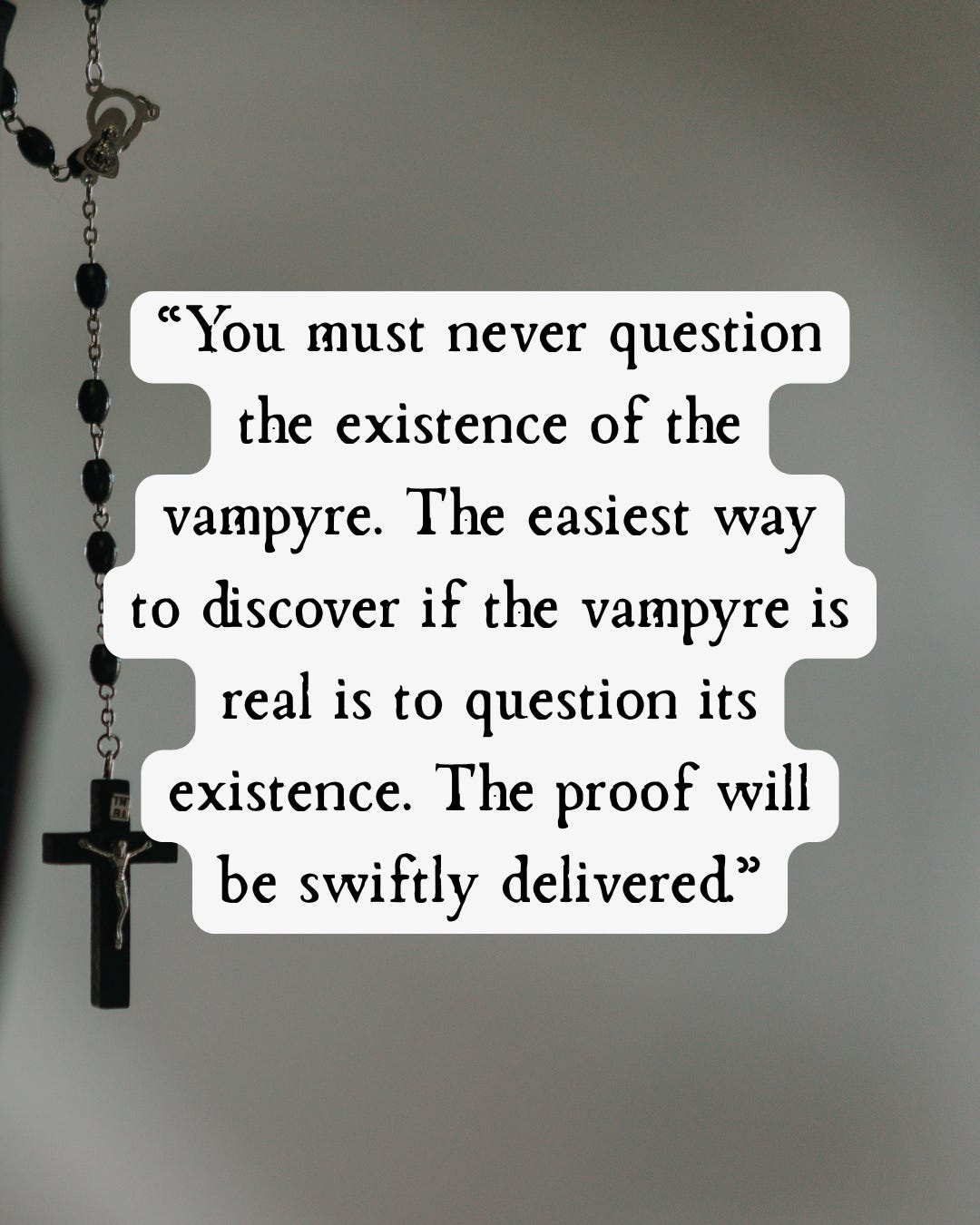
“The easiest way to discover if the vampyre is real is to question its existence. The proof will be swiftly delivered.”
I stiffened. “Then, what should I know about them?”
“They are creatures of the night. Born in the darkness. In a way, they are the offspring of the demon.”
“How so?”
“Demons make them.”
“How?”
“By giving a mortal man their blood,” he said, “and taking their soul in return. They are different from their sires. The vampyre can step foot on hallowed ground, but it cannot enter a church, or see the sun.. A crucifix or holy water can render them to nothing more than dust. The demon can play the human for as long as is needed to achieve its goal, but the vampyre is simply the monster that stalks us in the dark. It has no power in God’s light, or against those who carry His light into battle. But it is very much like the demon in the way it tempts us to become its prey or worse… one of them.”
Salome is very much a blend of religious horror and urban fantasy, drawing most of its inspiration from Catholic teachings on exorcism and demonology as well as folkloric legend and mythology. There’s a power that rests within fantasy where you really can do what you want with the right amount of world-building and lore.
My vampires in Muldoon’s world are drawn from the classic idea of the aristocratic Vampyre explored by John Polidori, and the Biblical explanation of demons and fallen angels as well as studies of exorcism. I also complicated things by establishing a vampire hierarchy.
Although Father John has told Salome that a vampire, ‘can step foot on hallowed ground, but it cannot enter a church, or see the sun’, he also explains later that, ‘This is the most common kind of vampyre I am telling you about, of course.’ There are others, and they are far more powerful.
Can a vampire be saved? Redemption and Salvation.
This is another fun one to explore because it really depends what this vampire is. Some vampires aren’t written as blood-sucking monsters but more metaphors for other things, or someone who is lost or soulless in some other way. When it comes to saving a vampire from itself, are we talking ‘take out the head vampire’ like The Lost Boys or is it a permanent state of existence now, like Dracula? This all depends on how monstrous or how simple or complex your vampire is. How are they made? Does one bite make every victim a vampire like in Salem’s Lot, or are the vampires careful about reproducing vampires, therefore only choosing a select few to join them? For many horror authors, the vampire is a permanent state of being, but we all have our own rules.
Salvation is a theme that features heavily in Salome, as is forgiveness and sin. I wondered how a vampire could fit into traditional Catholic teachings of sin, confession, forgiveness and redemption. I was inspired by The Exorcist and while that novel doesn’t have a vampire in it as such, it made me think about how a vampire can simply be a vessel for something worse.
Demons and vampires.
This leads me on to the connection between vampires and demons. In Buffy The Vampire Slayer those who become vampires can change their face between their human face and their demon face, though the human in them is long-dead. Essentially, when they become a vampire, their soul is in hell and a demon replaces the part of them that used to be their soul. This somewhat muddies the waters when we consider Buffy’s relationships in the series, but it’s just a story at the end of the day. I liked the hierarchy of vampires in Buffy The Vampire Slayer, I liked the idea of Spike redeeming himself. I liked the idea of vampires being linked to demons in that way.
Something that also inspired my lore of vampires in Salome was Kpop Demon Hunters. The demons and the focus on temptation, indulgence and listening to the negative voices made me reflect on demonic activity and the overall mission of demons in Christianity. They are legion, and they are many, and they can get under people’s skin without even their loved ones noticing. Father John explains it again:
“They are fallen angels or the spawn of them. Made by God.”
Demons are the main antagonists in Salome.
But given what I’ve said about the hierarchy, some are senior, demonic vampires, the first generation of demon spawn. It’s a warped form of creation, as the demon uses a body that already exists to make a vampire. The first-generation vampire is gifted with the same traits as the demon, but the vampire exists within a human vessel, and has an anchor on earth.
In the late 19th century when this book is set, revolutions, war and industrialisation in Europe triggered a crisis of faith, direction and morality in societies across European nations. The threat of evil and corruption was actually something Pope Leo XIII spoke out about throughout his papacy. He supported workers’ rights, fair pay and opposed exploitative Capitalism and Socialism.
He also wrote the Prayer to St Michael after experiencing troubling visions in mass. This is a prayer that features heavily in Salome.
Uncanny fact: I wrote this prayer into the story and created The Order Of St Michael before I’d even realised it was Pope Leo XIII who wrote that prayer in 1884. Salome is set in 1885.
The danger of demons and vampires in this historical setting.
Although Salome is more of a Gothic horror novel with elements of Urban Fantasy, I relied heavily on Catholic teachings of demons and possession to create the demons and vampires in this novel. Father John explains all to Salome on their journey from Genoa to Liverpool:
“Now pretend you have no one you know around you, and you are troubled. You have many sins in your heart, and you cannot seem to stop yourself from committing more. They are so plentiful now that you fear judgement if you go to God. Let’s say that you are desperate, and you do come across someone. They are kind and they listen to you, then they promise they can help. They accept you for who you are and what you’ve done. They can take your troubles away. They seem to care and ask for nothing in return. They would be easy to talk to, would they not?”
“Yes, I suppose.”
“Are you more likely to talk at length to someone like that about your troubles?”
“Yes. They would be like a friend, or a person in your family.”
“Yes. That is when the Devil strikes. What I said about asking for nothing in return: Sister, if you lend your ear to someone suffering, you ask for nothing in return. You give, because God has given you His love and you use it to bring His love to others. That is where the demon is different. After the demon has given so much, they lay out their fee. They have ensured that you only go to them, because you could not possibly put your trust in someone else. They know your secrets, your sins, and your shame, but they do not encourage you to repent. They let you indulge them. They make you feel justified in your decisions, excused for your behaviours. They tell you what you want to hear. You don’t need anyone else when you have them. Why go to God when this demon knows you better than you know yourself?”
My pulse quickened. “But God…,” I protested, “God is there.”
He raised a finger. “God is not. If you can only put your trust in a demon, you have shut God out. You gave in to fear and shame and self-pity instead of speaking to God. You didn’t turn to Him first. Do you see?”
Throughout the story, temptation hovers over the characters, almost a character in itself. Salome must fight not only to keep her own soul, but to protect others who can’t protect themselves. This is a lot of pressure for an eighteen year old novice. Her preternatural gifts only make the threat greater:
‘He looked around at the cool, clear night. “They are cruel, and some are so powerful that they can torment the mind of any mortal. Just think of what they could do if they turned a mortal like you into one of them.”’
Salome comes out on the 16th of October 2026.
Leave a Reply