I recently read the Gothic Horror classic Carmilla (finally!) after years of swearing I’d get around to it. To my shame, I’ve read Dracula twice (the second time to see why people love it so much) and while one is a novella and the other is a very long novel, there are some stark differences that I’d love to talk about. Carmilla, written by Irish author Sheridan le Fanu, was first released in 1872 is the story of a young woman pursued by lesbian vampire Carmilla. Dracula, written by another Irish author, Bram Stoker, takes us the story of an English solicitor who falls prey to a vampiric count in the Carpathian mountains, to then spend the rest of the story trying to prevent the vampire from his colonisation of Britain through a campaign of drinking blood and driving people mad.
Dracula and Carmilla: what the vampire represents.
Dracula serves as a metaphorical text about the spread of disease (whether of the mind or body), the fear of the unknown, the loss of authority and the destruction of an idealised Victorian society. Carmilla serves as a representation of repressed desires, exploration of female sexuality and the disruption to patriarchal norms of order and reason. The vampire figure in both stories highlights a few key anxieties for me:
- Male fear/ loss of authority.
- Desire over necessity.
- Fear of women in positions of authority.
At the time that both Carmilla and Dracula were written, women—rich or poor—in Britain did not have the right to vote. They would not win that right until 1918. Aside from New Zealand (Kiwi women got their right to vote in 1893, Aussies following soon after), it was a similar picture across the industrialised world in the 19th century. There were several arguments used against giving women the right to vote in Britain.
‘The birth and marriage rate are already decreasing.’ – Sir Charles Hobhouse, 1917.
Women were seen as impressionable, unable to make decisions without emotional input, unable to manage things as big as lawmaking, and of course, they were supposed to be in the home, managing that. With that context in mind, the notion of the Victorian female vampire is terrifying.
- She acts on her own volition.
- She does not have a home to manage.
- She rejects children and marriage.
- She chooses her lovers. They are not chosen for her.
- She follows her desires and dreams.
- She usually lives independently, comfortable in her own coffin or tomb.
- She knows her body. She knows what it is capable of (destruction) and is the agent of her own well-being.
Carmilla strikes fear into the hearts of men in the story, and this isn’t simply because she’s a monster. She is a dangerous female, and she is in control of the situation. Cunningly, she ensures that she is invited into the home, where she can come close to children and other victims, because she knows she’s a beautiful woman, and she is aesthetically acceptable.
The female vampire and the destruction of innocence.
Carmilla preys on young girls, though Laura is special to her. This could be interpreted to symbolise corruption of innocence in girls and young women, influencing them away from the gender norms of their time. Could Laura be more vulnerable because she is lonely and isolated? Carmilla represents far more than lesbianism: she is also a symbol of freedom.
The absence of the mother.
As with all good fairy tales, Laura has no mother to protect her from the vampire. In fairy tales (a noted predecessor to Gothic horror) the mother’s absence or ignorance can result in danger or death. In Dracula, Lucy Westenra’s mother removes the garlic that hangs over the window every night. She does not like the smell, and interferes with Van Helsing’s attempts to keep Lucy safe from the vampire. Mrs Westenra, like all of Lucy’s male suitors, does not believe in the supernatural. This of course leads to Lucy’s eventual destruction. Mrs Westenra is a product of a society that values logic and reason over superstitions and folklore, a trait shared with characters in Carmilla.
In Carmilla, it is Laura’s father who stands in the way of her wellbeing by running to science and reason any time something needs to be understood. It is General Spielsdorf who points this out to him:
‘I should tell you all with pleasure,’ said the general, ‘but you would not believe me.
‘Why should I not? asked my father.
‘Because,’ he answered testily, ‘you believe in nothing but what consists with your own prejudices and illusions. I remember when I was like you, but I have learned better.’
By this point in the story, Laura is gravely ill and cannot recover unless her father (a man of reason) accepts that there are powers that cannot be reasoned with, only destroyed with old methods (violence in this case). The general has lost his own child, and only in her death did he learn to accept that vampires are real, and in his ignorance, he allowed Carmilla to drain his daughter. He takes it upon himself to help others, and destroy the vampire for good.
Denial of female sexuality and the fear of lesbians.
More abstractly, we can also see here that the denial of lesbians existing enabled women to live together happily as ‘good friends’ or spinsters for centuries, under the radar. Before the Victorian age of reason, the famous 17th century lesbian nun, Benedetta Carlini sent shockwaves through the church for her unconventional methods of practising her religion (preaching from the pulpit) and of course, engaging in romantic relationships with other nuns. This terrified the architects of the status quo because if we consider how good Christian women and men only had sex to produce children (‘lie on your back and think of England.’) and how it was a marital duty, not a desire… this opens up a huge hole in the hull of the steady ship.
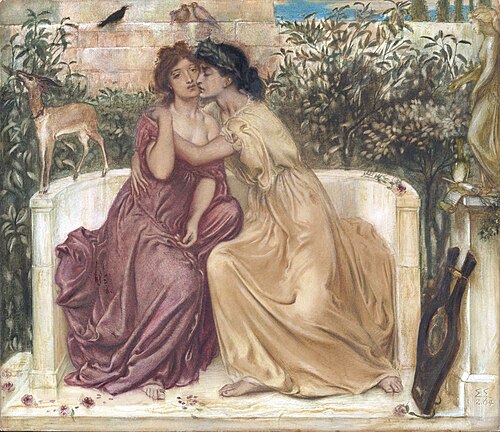
If men are not required for female satisfaction, they have no authority over the woman’s body. A woman wanting to have intercourse with another woman serves no reproductive function, it is purely because she wants to. Historically, marriage and sexual relations between the married couple did not require much wooing on the man’s part. In Victorian society, your wife is required to allow you to have sex with her. She does not have to want to, and you don’t have to seduce her. She certainly doesn’t have to enjoy it (See Married Love by Marie Stopes on the subject of 19th century sexual ignorance and liberation).
The denial of lesbians was as strong as the denial of the existence of vampires.
If you accept the existence of lesbians or bisexual women, there is now tough competition.
Those prosecutions disappeared later in the nineteenth century as the silencing of lesbianism became stricter. Respectable women were increasingly assumed to be sexually innocent and either passive or desireless. The best way to stop them trying a lesbian relationship was to ensure they were unaware of the possibility. – Lesbianism And The Criminal Law Of England And Wales, The Open University.
The very prospect of Carmilla the lesbian vampire making her way across the periodicals and bookshelves of Victorian Britain and Ireland is terrifying. She is a great threat to the patriarchal system that has kept law and order for centuries. Her influence, her beauty and her affection stirs curiosity in Laura.
‘Her agitations and her language were unintelligible to me’. – Carmilla
Could this actually be Laura entering sexual confusion? Confronting her sexuality for the first time in her life as an eighteen-year-old? Carmilla approaches her with tenderness, and her arms around Laura present a false sense of security. The wolf knows how to behave around the sheep in order to get an invite to the party.
‘Her murmured words sounded like a lullaby in my ear, and soothed my resistance into a trance, from which I only seemed to recover myself when she withdrew her arms.’ Carmilla.
When Laura develops a strong bond with charming, beautiful Carmilla, she doesn’t understand her own feelings. Laura has been raised in a structured, patriarchal system that makes its values clear: women are vessels for male desire. Women are mothers and wives. Women marry who is the best fit, not who is the best in bed.
Carmilla acts on her feelings all the time. Another terrifying trait in a Victorian female. She talks to Laura passionately without much provocation, saying that ‘You will think me cruel, very selfish, but love is always selfish; the more ardent, the more selfish.’
The selfishness could well be that a woman choosing another woman is not ‘for the good of the many’ as no children are coming out of that union, and there is no husband to serve, no house to keep. The selfishness of love is also what causes extramarital affairs and divorce (once a huge Victorian taboo). Carmilla is a terrifying symbol of female self-determination as well as desire.
Mina Harker: the image of the perfect Victorian female.
In contrast to Carmilla and Laura, we have Stoker’s heroine, Mina Harker.
Mina’s devotion, her purity, her solid contrast to the monstrous Dracula really occupied my mind while I was reading Carmilla. Mina doesn’t seem to suffer the same level of loneliness and desire for companionship as our narrator Laura does in Carmilla. Mina is very much modelled on the Victorian ideal of the ‘Angel In The House’, Victorian propaganda supporting gender roles and subjugation of women for their own perceived good.
An attack on Mina as a wider attack on the Victorian way of life.
Dracula putting his ‘reeking lips upon [Mina’s] throat,’ with a ‘mocking smile,’ and then making her drink his blood is rape. The assault on her way of life and the society she represents is the ever-present threat to the characters and their world in this vampire novel.
The vampire of the 19th century represented much more than a monster in the shadows, though the meaning of the shadow has changed over time.
The vampire serves as an enduring symbol of the perceived threat to whatever the current considered ‘normal’ way of life is. It can be corruption, progression, sexuality, deviance, mental illness and the stigmatisation associated with it. It can represent old ways in a world of ‘new ways’, or a mirror for the characters’ own thoughts and feelings as they process whatever is happening to them. Think of the vampires in Salems Lot and how they serve as a metaphor for globalisation and the loss of community in small towns. The local, family-owned businesses are absorbed by faceless corporations, never to be seen again.
When Anne Rice was writing Interview With The Vampire, the LGBTQ community survived on the fringes of modern society, their ability to love, live together and marry still regulated by policymakers and heavily stigmatised. Lestat and Louis represent the outsiders forced to live in the shadows of what is considered ‘proper’ in 20th century American society.
The vampire is eternal, and will always find relevance.
Final thoughts on Carmilla.
Carmilla is a triple threat: A woman, a vampire and a lesbian. This makes her a terrific antagonist for a Gothic story,
I loved this book and everything it represents about my favourite period in both literature and history: The Victorian era. The notion of a female character acting on her own impulses, desires and demands may well have been interpreted by Victorian audiences as more terrifying (and secretly titillating for male readers) than a supernatural monster.
I’d recommend Carmilla to anyone who enjoys classic Gothic Horror and vampires. It is essential reading.
Read more about Gothic Horror and The Supernatural.
- 5 things Angela Carter Taught Me About Horror.
- Egyptian Gothic.
- 5 Things Anne Rice Taught Me About Horror.
- What is Gothic?
Hanna Delaney is a horror author from Liverpool. Her debut novel Oceanus was released in 2024. She writes Gothic Horror and the Muldoon supernatural thriller series, crime thrillers that blend Victorian Gothic with supernatural suspense.
Leave a Reply