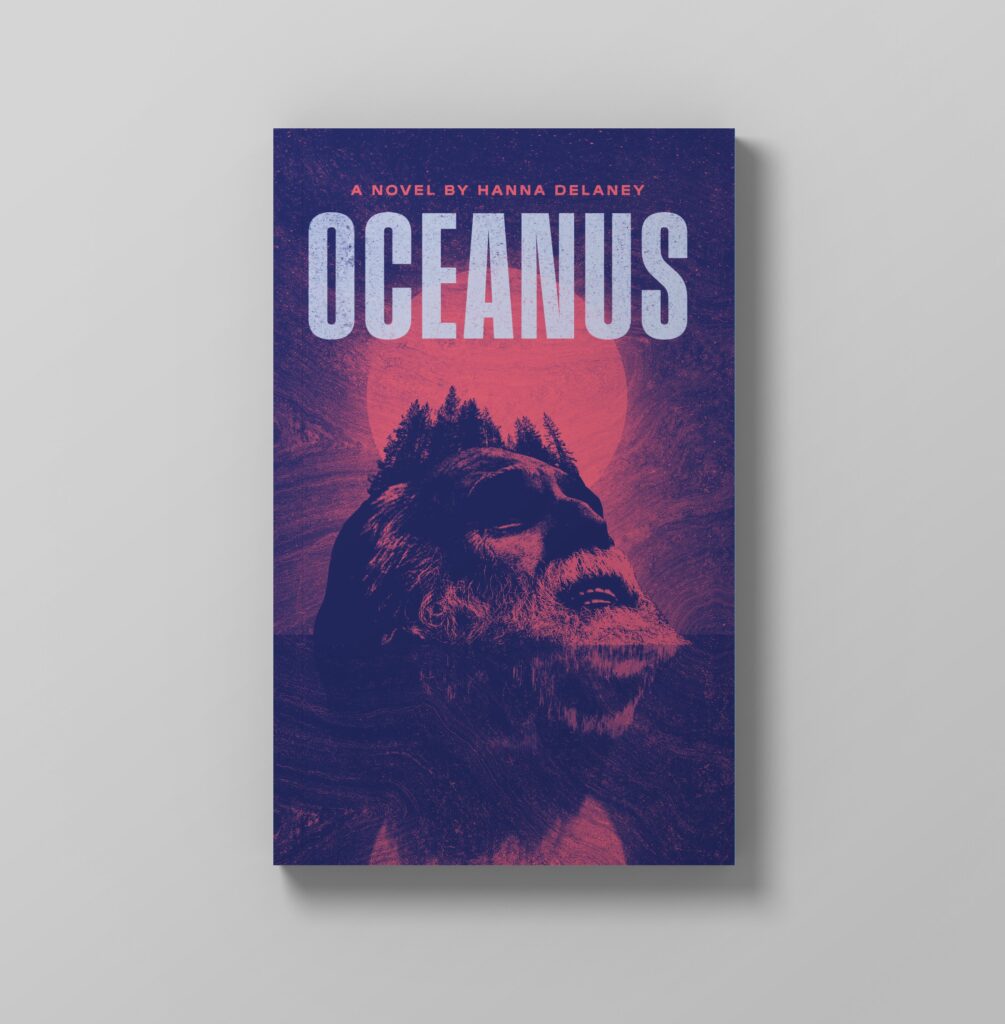
Oceanus is a science fiction mystery novel and when I was writing it, I drew inspiration from many sources, many of them not very obvious based on the blurb alone.
A starship drifts, its crew gone. The planet it orbits has no name. Survivors are separated on the surface. Exhausted. Hunted. Lost. The longer they stay, the less they can trust their own minds. Their captor is as patient as he is bent on revenge.
Some prisons have no walls.
This story from the blurb alone is about revenge, but in the original blurb it also mentioned redemption, love and forgiveness. Among other things such as man’s eternal quest for knowledge and the opportunity to steal fire from the gods, it’s also about the child outgrowing the parent, breaking the bonds of the protective net.
These themes aren’t new, and neither are the stories you find them in.
What’s this story actually inspired by?
This story is loosely inspired by The Tempest with the characters mirroring those from the classic play: Balthazar/Boatswain/Trinculo, Thea/Miranda, Derrien/Prospero, Anthony/Antonio, Jet/Caliban, Geraint/Ferdinand, but this is very much its own story otherwise. You don’t have to know the play to appreciate this novel, just like you don’t have to have read or seen the Taming Of The Shrew to appreciate and understand Ten Things I Hate About You.
That’s not to say it’s not drawing inspiration from other places. All science fiction can trace its influence across millennia. I would argue that Greek mythology kicked it off: Think Icarus flying too close to the sun and what that represents when it comes to science, technology and nature. Think of Prometheus and how stealing fire from the gods returns in several forms throughout science fiction (Mary Shelley’s Frankenstein being the most obvious one—it was The Modern Prometheus after all).
The natural, the spiritual and the moral come up throughout science fiction and fantasy. This is simply because it has been created by people, and we can’t help putting ‘a little of every artist in their work,’ (Blade Runner 2049).
The Little Mermaid and the immortal soul.
When The Little Mermaid was first published in 1837, it was a Christian children’s story about the quest for an immortal soul. A little mermaid dreams of coming to the surface and walking among men. She learns that humans have immortal souls that do not die with their bodies. Mer-people in contrast have no graves, and they become sea foam when they die. The Little Mermaid is well known as a fairy tale of a mermaid who loves a mortal man, but in the original tale, she also seeks a soul.
‘The mermaid has no immortal soul, and can only acquire that heavenly gift by winning the love of one of the sons of men; her immortality depends upon union with man. Neither do the daughters of air possess immortal souls, but they can acquire them by their own good deeds.’
Selflessness is celebrated as a human trait, and good deeds like that are worthy of a soul.
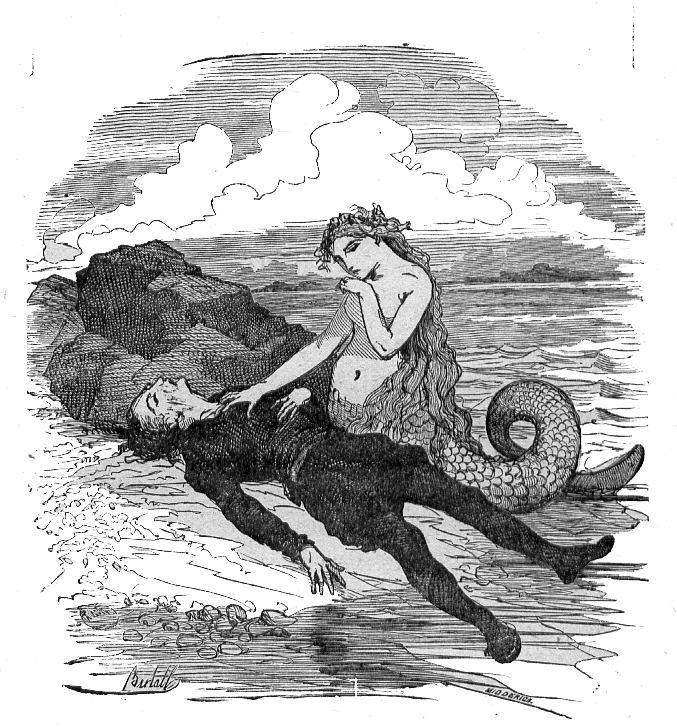
Bertall (1820-1882)
Coming of age: The wonder comes before the fear.
Thea stands in the front room of her father’s cottage, staring out into the sky ‘still, huddled, watching the storm in controlled awe,’ and she doesn’t immediately act. She is awestruck before she is concerned. The same happens in Andersen’s tale where the little mermaid finds the storm ‘most delightful,’ but as with both Oceanus and this fairy tale, ‘the ship’s crew thought very differently’.
The little mermaid, realising its dangerous, rushes to help a ship’s crew when it is caught in a storm.
it became pitch dark so that she could not distinguish anything; presently, however, a dreadful flash of lightning disclosed to her the whole of the wreck. Her eyes sought the young prince—the same instant the ship sank to the bottom. At first she was delighted, thinking that the prince must now come to her abode; but she soon remembered that man cannot live in water, and that therefore if the prince ever entered her palace, it would be as a corpse.—The Little Mermaid.
I read this story again recently, and the similarities were eerie. It’s funny what sticks. This scene is quite similar to the opening of Oceanus where Derrien and Thea see vessels crashing through the sky. Derrien instructs her to help the vessel crashing into the loch.
At first, the waves were too high for her to capture sight of the shuttle clearly. Only when they started to subside did she see that it had started to sink. The water glugged greedily, pulling the helpless vessel down into the black depths. A break in the clouds brought with it a small beam of light that revealed a grey bow still visible for a few more seconds until the loch would consume that too. —Oceanus.
But starting with a storm isn’t unique to The Little Mermaid. It’s also how The Tempest starts. Miranda doesn’t jump in and save anyone though.
‘Against my very heart! Poor souls, they perished.
Had I been any god of power, I would
Have sunk the sea within the earth or ere
It should the good ship so have swallowed, and
The fraughting souls within her.’
She witnesses the storm and the ship sinking, but there isn’t any opportunity for her to do anything. Prospero also quickly tells her nothing is actually wrong. It’s all magic.
The parallels don’t stop there, but I’ll try and keep this to the point. Oceanus is set in a world where AI is outlawed, and humans are as fearful of artificial life as they are of aliens. Both represent the fear of the unexplained (or known magic/witchcraft) on a new frontier: the colonisation of space.
Oceanus is set in the 24th century, and we haven’t changed much.
After a series of dark passages in a yet-to-happen past, governments united and agreed to stop creating synthetic life. You’ll find out why in the book if you haven’t read it already, but Derrien makes it clear that the demand to ‘make it real’ has cost humanity greatly.
Now we run into Philip K Dick territory. The questions over sentience, consciousness and whether man-made androids (or beings if we’re talking Mary Shelley) can have a soul have hovered over science fiction for centuries. Why do we feel so much sympathy for characters who are not human? Why do we hope the little mermaid will finally get a soul and go to heaven? Why do we feel so much for the creature that Frankenstein has created?
‘The fallen angel becomes a malignant devil. Yet even that enemy of God and man had friends and associates in his desolation; I am alone.’— Frankenstein
In Brian Aldiss’ Supertoys Last All Summer Long we feel that pang of sadness, a realisation that the android’s life is going to change forever. In Blade Runner 2049, we find ourselves sobbing over Deckard’s throat catching when he says, ‘Her name was Rachael.’ or ‘Her eyes were green.’? Why do we care so much?
Because there is a lot more to being human than we think.
‘Why have not we immortal souls?’ asked the little mermaid. ‘I would willingly give up my three hundred years to be a human being for only one day, thus to become entitled to that heavenly world above.’
The selflessness, sacrifice and loyalty to others is something that the little mermaid discovers she is capable of. The prince marries someone else. She is heartbroken. It would have been a very human thing to do to murder the love rival (not that this is moral, but it is within our nature) for her own satisfaction and chance of securing the prince for herself, but it is also human to try and celebrate happiness for others even when you’re dying inside.
Cutting family ties. Choosing what’s right over what’s least upsetting.
The theme of loyalty and the ties to family is something I’ve explored in Oceanus. The storm is the catalyst for Thea, as she first sees Derrien for who he really is: ‘“Father,” Thea said, her own voice surprising her, “what have you done?”’ However when she meets Geraint, she sticks to what she knows:
“Thea, please can you help me find my father?”
“I’m not sure if I can.”
“Why not?”
She paused for a moment, and rested her hands on her lap. “Father hasn’t told me to.”
He smirked. “You need to ask your father?”
“Of course. I always ask my father.”
Both of these characters will break away from their fathers as the story continues. Another similarity with the little mermaid defying the sea king’s laws. The child needs to carve out an identity for themselves, even if most of the process is painful.
The little mermaid is offered a solution to her misery. She is trapped on the human world and doesn’t have the prince she sacrificed everything for. Her sisters come to the surface and suggest: ‘Before the sun rises, thou must plunge it into the prince’s heart; and when his warm blood trickles down upon thy feet they will again be changed to a fish-like tail; thou wilt once more become a mermaid,’ and tell her that her ‘mother mourns for [her] so much her grey hair has fallen off through sorrow.’ This does not make the mermaid’s choice easy.
What she does next is not what her family would want for her, but it’s her choice.
‘All at once, she threw far out into the sea that instrument of death; the waves rose like bright blazing flames around, and the water where it fell seemed tinged with blood. With eyes fast becoming dim and fixed, she looked once more at her beloved prince; then plunged from the ship into the sea, and felt her body slowly but surely dissolving into foam.’
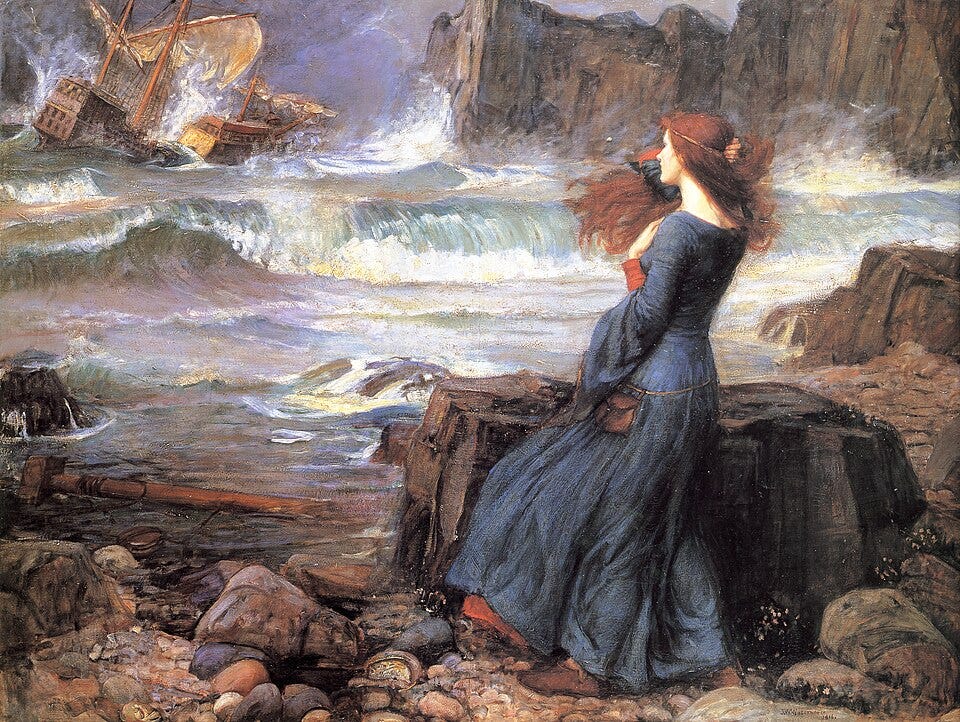
Miranda, a character in “The Tempest”, a play by William Shakespeare. John William Waterhouse.
The Storm As A Catalyst
The storm is the catalyst in all three stories: It is the beginning of The Tempest, the shift in The Little Mermaid and the point of no return for Thea in Oceanus as she learns the man she idolises may well be a monster. Realising what she’s seeing, she says: ‘“Father, what have you done?”’
The storms are symbolic: the initial build of tension that then results in a thunderous release. For the little mermaid, the storm is the moment she becomes ‘of age’ and must decide things for herself. For Prospero and Derrien, the storm is ‘perfect’ so to speak and will bring their enemies into their hands so they can exact the revenge they’ve been dreaming of for years.
But the storms can also represent the inner turmoil of the characters. It is the storm that separates Geraint from his father and throws him into a territory where he has to work it all out for himself. His privileged, princely life is forever changed. Thea must weather a storm to get through to her father and steer him away from further madness.
She shook his slack head and shoulders violently on the sand. His soaked hair and clothes made him heavy. She could not hear if he was breathing over the howling winds and heavy rain.
“Stop it!” she screamed.
Exceptionalism and Icarus
The Greek story of Icarus holds great bearing on science fiction and fantasy. Often, we will have a sorcerer, a wizard or a scientist who is reaching high, far too close to the sun. He will have been warned, or even seen examples of those who’ve gone before and failed miserably. The wax melting symbolises man’s folly, the sacrifice of other aspects of an individual’s life in order to obtain knowledge or power. The exceptionalism is something I wanted to explore in Oceanus. Derrien is banished from his home planet (you’ll find out why) for his inability to respect the rule of law. His desire for knowledge overpowers any sense of morality.
When faced with the apparition of Dr Shona Lennox who warns him in a very Jacob Marley-esque way to back off the project and go home, Derrien still can’t see the danger.
This thing is far worse than anything we can make.”
“Oh Shona. Just think of the potential,” he said. ‘The potential’. He thought of all ‘the potential’ that had come before. His mind flitted from stance to stance. He struggled to think of any ‘potential’ that had truly helped mankind in his living memory. In the face of former unseen catastrophes, Derrien still believed that this time was different. This time, he was right.
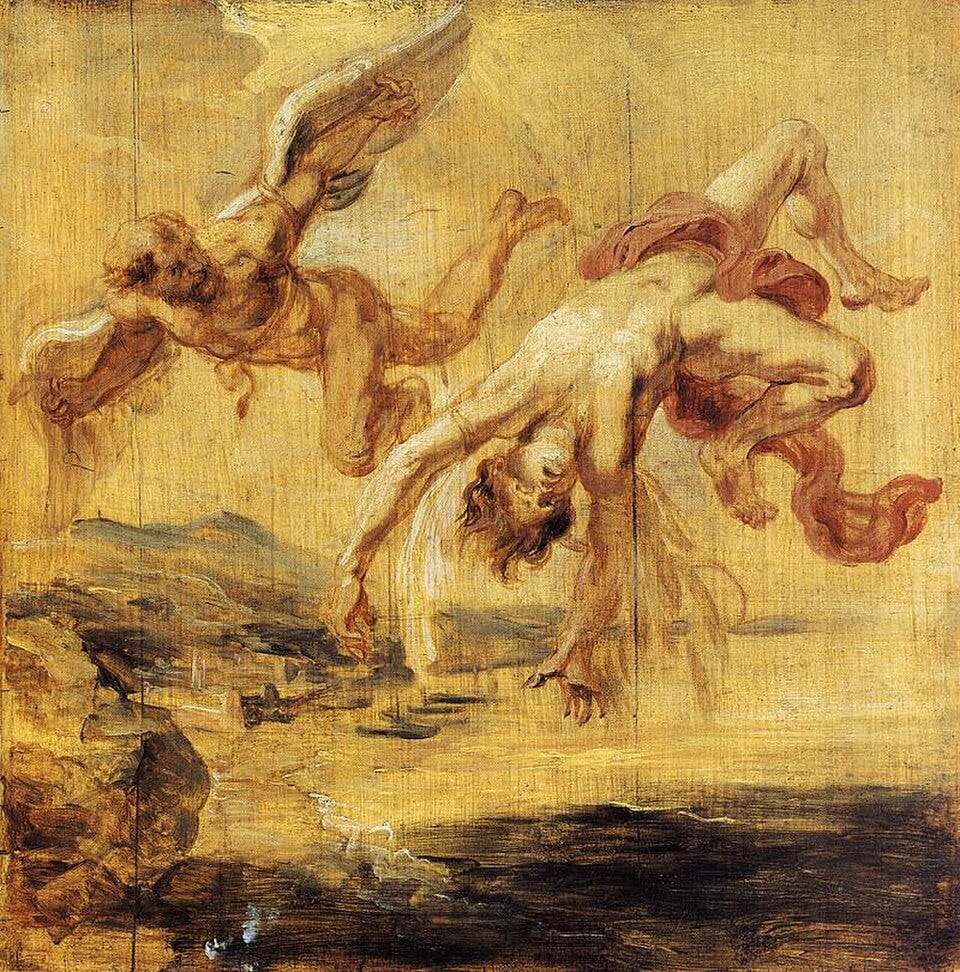
The Fall Of Icarus, Peter Ruebens.
In the story of Icarus, Daedalus the inventor warns his son not to fly too close to the sea, or the feathers of his wings will get wet and he’ll drown. He also says not to fly too high or the warmth of the sun will melt the wax that holds his wings together. Icarus is young, giddy and so taken with the experience of flying that he forgets his father’s warning. This story resulted in the immortal idiom ‘Flying too close to the sun’. The ambition or the exceptionalism is something that lingers over science fiction today. It reminds me of a great line you’ll probably know: ‘Yeah, but your scientists were so preoccupied with whether or not they could, they didn’t stop to think if they should’.
Derrien—just like Prospero—is the architect of his own misery.
Oceanus and empathy
Empathy comes up as a theme in many works of science fiction, but let’s start with The Tempest. Prospero feels little empathy for the shipwrecked passengers at the beginning of the play. He has been wronged, and he cannot see past that. It is Miranda who starts the play with a greater sense of empathy; and it’s actually Ariel, the enslaved spirit, who tries to teach Prospero empathy. By act five he suggests that if Prospero could see the state the men are in, his ‘affections Would become tender’. Prospero is taken aback by Ariel’s suggestion asking him if he really thinks so, to which Ariel replies, ‘Mine would sir, if I were human’.
Empathy being used as the gateway to forgiveness and tolerance re-emerges in other works such as in Dick’s Do Androids Dream Of Electric Sheep? ‘Empathy, evidently, existed only within the human community, whereas intelligence to some degree could be found throughout every phylum and order including the arachnida’. Deckard himself wrestles with his understanding of empathy. It first seems that caring for a sheep is a way of meeting the baseline for empathy, but it’s when he begins to feel guilt and regret as he retires androids that he realises his empathetic abilities. The entire novel hinges on empathy, as this is where the line between artificial intelligence and humanity blurs.
In Oceanus, empathy comes naturally to some characters but not others. Ironically, it is Derrien who teaches Owen to find his empathy:
‘Owen thought about the fear he saw in Derrien’s eyes when he couldn’t find his daughter; he knew the same feeling too well. It was the fear of a father.’
While there are countless traits and behaviours we can clearly attribute to being human (some of them deeply unpleasant) I feel that empathy and compassion are the ones that instil a sense of hope in any imagined futures we write and read. Even in the darkest dystopian stories, the hope starts with empathy. In Octavia E. Butler’s Parable Of The Sower, it is Lauren Olamina’s empathy that changes the course of their future. The next step is compassion, the overwhelming desire to relieve others of their suffering.
Conclusion
This book was inspired by many things, but I’ve summarised the main influences on the text. Stories to me are deeply human, and I prefer to write character-driven stories, no matter the genre.
As fun as it would have been to write something similar to Forbidden Planet (The Tempest in space) that’s not really what I’ve done here.
Oceanus is out now, published by Tiny Worlds Publishing. You’ll be able to get your copy of the paperback or e-book from Tiny Worlds directly and anywhere that sells books online.
Leave a Reply