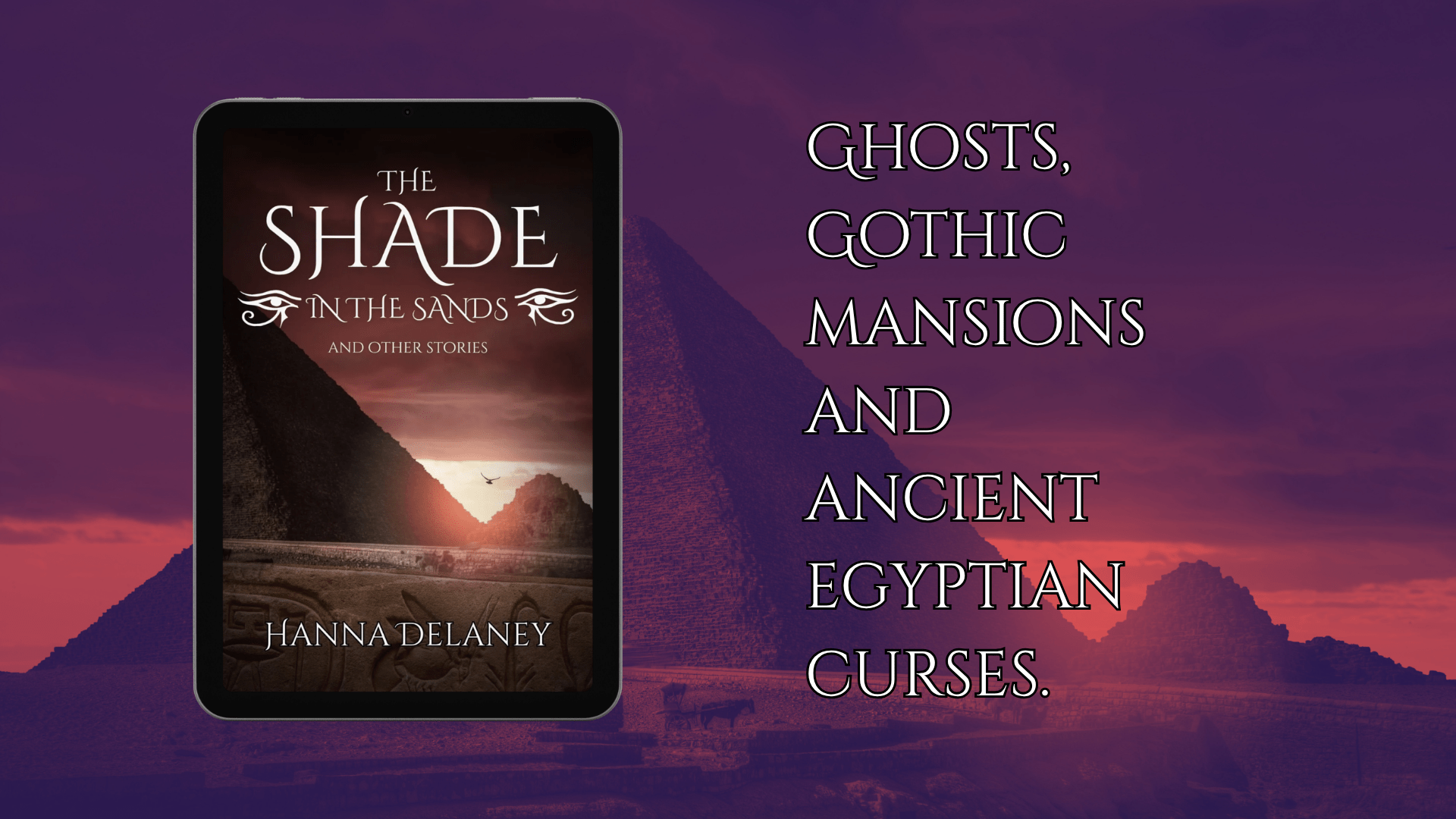
Inspired by classic Egyptian horror stories such as Lot 249 and The Ring Of Thoth, I published The Shade In The Sands And Other Stories last year. It is a collection of short Gothic stories centred around the historical phenomenon of Victorian and Edwardian Egyptomania.
You can read a sample of The Shade In The Sands, a Gothic Egyptian horror tale here:
Giza. June, 1888
I pass the hawkers and walk through the bustling bazaar, the perfumes and scents of spices drawing me towards the fresh sweet breads, cakes and delicacies. Children laugh and run rings around the patrons. One boy holds his donkey’s reins and waits for his father to finish his conversation with a vendor. They speak with their hands, talking in impassioned Arabic, and I guess that it is about the weather, as they point at the sky and shake their heads, folding their arms disapprovingly.
I go further inside the shade of the bazaar. The sweet aromas clash heavily with the faint smell of bitumen. I had not expected them to be here. Bodies, or just parts. I have been here long enough to know these are no kings lined up against the wall. I don’t know who they are, but the real nobles find their way into European homes, bottles and even hearths. I look away, but I don’t need my eyes for this. The oils burning in the lamps thrust my imagination into an adventure through time. I imagine bare hands rubbing the sleek, glassy oils on the skin of the dead, sealing them inside themselves forever. My eyes wander to the hieroglyph of a wall that’s not here in the bazaar, and I realise that I imagine too much. I beg my mind to look away, lest the dead wake and witness me watching.
I stop at a fruit stall and indicate to the woman that I’d like some dates. She nods and scoops them into my small sack, holding her hand out for the money. Her black robes are sheer, and I can see her slim neck and collarbones under the muslin. She wears an elaborate niqab, like many women here do. Only her amber eyes are visible beneath dark waves of hair around her temples, and she reminds me of a woman I photographed once, and never saw again. I look at her for a moment longer, desperately seeking the face of someone else. She could be her, for all I know. Her eyes are looking at me inquisitively. At any moment, she will say my name, and my condemnation to hell will be a vague memory of something that never happened. My heart leaps, only for her to study me strangely. I blink again and it is not her. She is beautiful, and so was Minnie Wainwright.
We shared a moment, and that’s all it was.
I lift the bag of dates and pay the hawker. She gives me one more glance and serves another customer. Perhaps she thought she recognised me. Perhaps she thought I was a tourist, and wondered why I’d be out there by myself. Perhaps none of this happened, and I am but a prisoner of my tortured mind. The miasma of camel, bodily odour and waste reminds me that I am still alive, and the hell I live in is as tangible as the hemp sack in my hand.
On the way home, I pass the Zangaki brothers’ cart as it passes on the main road. If any tourists ask where they can have a photograph taken, or buy a postcard, the Zangaki name is on the tip of every local’s tongue. Once, the known name was mine. The cart passes, the men driving it seemingly unaware of my existence. In another life, we would have met. Their success reminds me of my failure; like the groan of an empty stomach, it distracts me greatly, and it is a hunger that I know will never be sated. In the spirit of what I once shared with my English kin, I look at the Zangaki cart, summon good sportsmanship and think good for them. They seem to get everywhere. Perhaps I will make a toast to them later. Long live the Zangaki. The thought tastes as bitter as unripe fruit. The dry dust of the road floats up from the wheels of the cart and consumes me. It’s what I deserve, I suppose. I return to my studio and lock the world out.
The bell at the top of the door tinkles pitifully. The hinges are sand-stiff and will need maintenance. I have known this for months. The wood of the door is worn and splintering, but it is still a door, and it is a door that will close. I shut it and lock it, standing there for a moment to admire my home.
My studio is carpeted with dust that occasionally blows up like a miniature sandstorm across my gallery. I let it sit, and like an affectionate stray, I let it stay. It coats the edges of the frames and dulls the glass of my collection, but not her photograph; dust won’t touch it.
I check my room for my bottles. They are safest under the bed. I never go in the dark room now, even though it would be the perfect, cool sanctuary for the wine and the spirits. My friends at the bar of Mena House supply me with my medicine, and like good friends, they ask no questions. It almost makes me laugh to think they once fretted about hurting my feelings by asking me to come in through the staff entrance, but they forget I try my best to have no feelings. I do what is required of me. I pay, and I leave. I don’t linger anywhere for too long any more; I do not want to be pitied. I wouldn’t want it to infect me. I know Aziz disapproves of my habit, but he is also a good friend, and prays for me instead.
My parents still send my allowance. I tell them business is thriving when I can bring myself to write. They ask no questions. If they were to ever ask what I was doing with the money, I fear I’d tell them the truth.
My afternoons pass numbly, unconsciously. I assume it is every day, because it’s a habit, but I lie there in a botanical stupor for most of the afternoon. I don’t know what time it is; I stopped winding my clock long ago. There was, and still is, little point in keeping track of nothing. Like the pharaohs in the tombs surrounding my little shack, I am a husk of what I once was. Unlike the pharaohs however, I have never been great, and I shall never be great.
I think about her every day. I think about how I didn’t hear her knock, and whether that really happened. Perhaps she wanted to sneak past me. Perhaps there was no trust there, and she had to see for herself. Whatever the plan, she managed it. She saw what I was, and I will never forget the pity in her eyes as she looked from my empty bottles to me, a shambling knight in rusting armour.
I didn’t hear her knock that night.
By the time I’d found her in the cellar, it was too late.
“Tom…” she said, her voice breaking. “Tom, it’s him.”
“No,” I said, trying to reach for the photograph. “No, it’s a technical fault. It’s nothing, look—”
She backed away from me, concealing it. “Why did you lie to me?” She was crying now.
“Minnie, I didn’t…” What could I say? I didn’t kill him, but I knew he was dead. How could I tell her that without making myself sound like the villain when the heroine of the story finally unmasks him?
She saw the photograph, and she believed. “He’s out there somewhere!” she cried. “And you lied to me!”
“Minnie, please. That isn’t Michael.”
“He’s…” she stopped suddenly, looking down at the photograph. “He’s…”
She saw it too. “Minnie,” I said, approaching her slowly, “we should get out of here.”
My rapidly-beating heart seemed to come to an abrupt halt when the first howl of the rising wind edged its way through the gap in the cellar door.
It was too late.
The Shade In The Sands: About these Egyptian horror stories.
Each story in the collection hovers somewhere around the Mummy films and Anne Rice’s Vampire Chronicles, but the setting is definitely a homage to classic Gothic and Horror authors such as Arthur Conan Doyle, Bram Stoker and Louisa May Alcott.
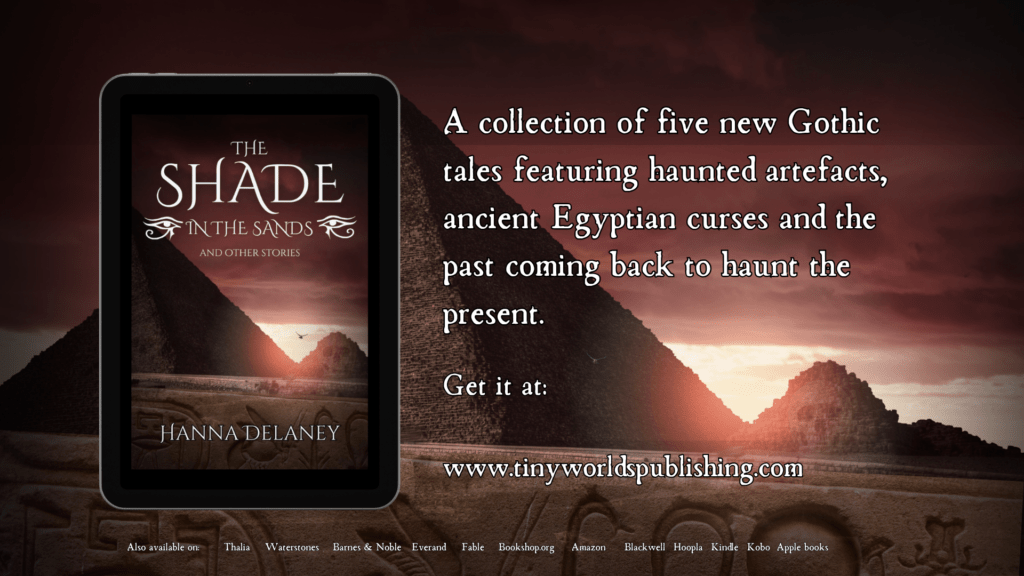
The Shade In The Sands And Other Stories is a Gothic Egyptian Horror collection. Read more about the five featured Gothic stories below.
This was one of the most exciting projects I’ve ever worked on, pushing me into new territory, both with the length of the ‘short’ stories I’ve written and the genres of the stories. Although these are all very much Gothic horror, the challenge of delving into more Gothic romance than I usually do was one that I thoroughly enjoyed. You can blame Anne Rice and Arthur Conan Doyle!
Now available: Egyptian horror and Gothic darkness come together in this one collection.
I’d like to say a huge thank you to Emily S Hurricane for her expertise and assistance with The Woman With The Emerald Eye. Emily’s work spans multiple genres, but her romance work made her the perfect person to come to for feedback in this case.
These five stories have been inspired by the greats who have gone before me, and I hope that I have been able to add something new to this sub-genre of Gothic Egyptomania:
- The Shabti: In the midst of the Blitz of 1941, precious Egyptian artefacts are transported from The World Museum in Liverpool to nearby country houses for safe keeping. The Ecklands receive a Sarcophagus and some smaller treasures in their country home in Frodsham. All seems fine until Mr Eckland takes a mysterious woman as his lover… a woman who he’d do anything for, whatever the cost.
- Six Geese a-Laying: Young Timothy Wicklow arrives at Harewood Court for a Christmas party in December, 1920. He doesn’t know the host, but as he has no friends or living relatives to spend Christmas with, he accepts. Around a blazing hearth, Mrs Virginia Dawson-Langley will tell him a Christmas story that will change his life forever.
- The Shade In the SandsTom Parker, a young English photographer based in Giza, hasn’t taken a photograph in over six months. When the wife of his missing friend arrives in Giza on the anniversary of her husband’s death, Tom must face the horrors of what happened a year before, and prevent anything from happening to her, too.
- The Maiden’s Hand: Peter’s cousin Wilfred has brought his university friends to their country home for the weekend. Peter’s uncle, a successful explorer, has many Egyptian artefacts around the house, including one he calls ‘The Maiden’s Hand’. Peter finds himself inexplicably attached to the mummified hand, and when his cousin’s guests awaken something as old as it is sinister, Peter must break the curse before the world as they know it is over.
- The Woman With The Emerald Eye: Colonel Lindsay and his wife host their friends for Christmas and New Year. At an unwrapping in the colonel’s study, his elderly mother takes a macabre interest in the body of the woman on the table.
Read Goodreads reviews for The Shade In the Sands And Other Stories.

More on Gothic Egyptomania and Egyptian Horror:
- Books about Gothic Egyptomania
- Mummy Horror
- Mummy Horror and Romance: Anne Rice and Arthur Conan Doyle
Hanna Delaney is a British author from Liverpool UK specialising in speculative fiction. Her debut novel, Oceanus, was released in September 2024. She has since gone on to write the Muldoon supernatural thriller series set in late-Victorian Liverpool and Salome, a vampire novel.
Leave a Reply