Possession as we know it seldom involves consent… or does it? If you think of The Conjuring, or Evil Dead, something is unleashed and takes possession of the victims, whether they know they invited it or not. It’s actually the start of plenty of good horror stories. Someone usually unwittingly (or mischievously) opens a box, reads from a book, lights the black flame candle… They dabble with tools that unleash powers that they cannot comprehend, or do not believe exist until all hell breaks loose.
I wanted to look at possession in horror and how the demon who possesses the victim seems to be invited in, just like the vampire.
When writing Salome, my newest horror novel about a novice’s journey to becoming a vampire slayer, I realised that there are a lot of examples of possession where the evil has been invited, even if the host is not able to explicitly give consent.
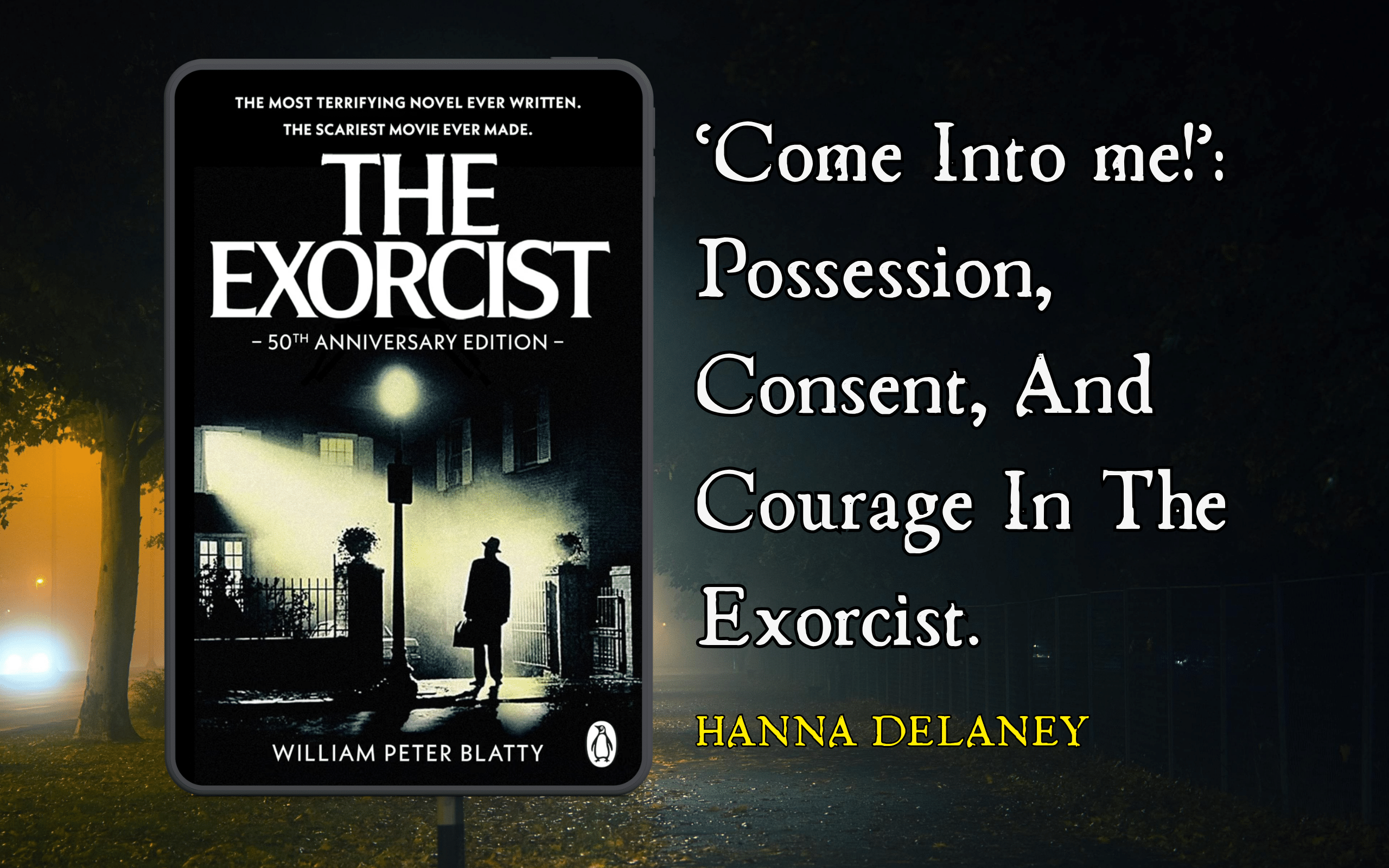
I cannot write an essay about exorcism and possession without mentioning the foundational text in this sub-genre of religious horror: William Peter Blatty’s The Exorcist. In The Exorcist, 11-year-old Regan McNeil is possessed by a demon, its grip on her bringing her closer to death with each passing day. Her curiosity and boredom leaves her vulnerable to possession by Captain Howdy in the first place.
‘”You been playin’ with the Ouija board, Rags, honey?”
“Oh , yeah.”
“You know how?”
“Oh, well, sure. Here, I’ll show you.”
Regan was moving to sit before the board.
“Well, I think you need two people, honey.”
“No, ya don’t, Mom: I do it all the time.” – The Exorcist, William Peter Blatty.
Our assumption of possession in modern popular culture is that it can happen to anyone at any time… but in Blatty’s classic horror novel, the demon is invited. Playing with the Ouija board is considered by exorcists as an easy way to invite temptation, sin and of course, demons, if you ask often enough.
In his book The Rite: The Making Of A Modern Exorcist, Matt Baglio talks of Ouija boards and how they can become more than we intended. Father Bamonte explains:
‘Using a Ouija board does not necessarily risk possession. Yet engaging in this activity repeatedly, he says, could start people down a path that could open them up to possession either through a graver sin or through their own actions.’
If we think of The Exorcist, Regan is just a curious, bored and lonely kid. That sense of curiosity and need to find answers opens her up to something evil, and even though her mother is not religious and doesn’t necessarily believe in evil spirits and ghosts, there’s something that makes the hairs on her neck stand up, because all fear is real:
‘Chris was fearful that her daughter was repressing both anger and grief and that one day the dam would break and her emotions would erupt into some unknowable and harmful form. Chris pursed her lips. A fantasy playmate. It didn’t sound healthy.’
And in this case, it’s most certainly not healthy. You really feel for Chris McNeill in The Exorcist: her husband left her when her career took off, but that’s not the worst of it. Chris loves her only living child deeply (she lost her other child to an illness when he was a toddler) and it breaks her heart when Regan’s father forgets to call, even on the child’s birthday. You can imagine it’s a vulnerable situation for both characters: The mother worrying that she isn’t doing enough, and the child feeling so discarded and lonely that she is searching for something, anything to fill the void, even if she is too young to realise. Chris (and the reader) realise something is going wrong, but don’t have the full facts of what, who or why yet:
‘”Honey, who’s Captain Howdy?”
“Oh, you know, I make questions and he does the answers.”
“Oh, yeah?”
“He’s very nice.”‘
Of course he’s very nice. If demons can get in as a result of temptation… it has to be really tempting, doesn’t it? They promise things, and take the pain away. Captain Howdy is ‘very nice’ to the little girl, because he has to be. The Devil tried to tempt Christ in the desert with two essential things: food and water. Who wouldn’t feel better after drinking some water when they’re thirsty and eating food when they’re starving? We all would. Well, I mean Jesus is Jesus for a reason, but as for the rest of us… It’s very tempting! Captain Howdy has to seem approachable, kind, accessible and always there for the little girl who feels the grown ups are too busy to play with her. It’s really horrifying when you think about it, isn’t it?
The scene in the book with the Ouija board is the moment things start to change in the house. Strange noises start making themselves known in the loft. Furniture seems to move of its own accord. The demon is inside now, and it won’t leave.
One of the particularly horrifying things about The Exorcist is that the victim is a child. The readers are no doubt thinking as they read, Why would God allow this? She’s a child!
The innocents are the most coveted.
Religious horror often demonstrates the battle between good and evil. In The Rite by Matt Baglio, he writes that, ‘Many have asked the question: Why would God allow the Devil to harm us? While not easy to answer, Catholic theologians such as Thomas Aquinas have tried to show that ultimately, God permits the Devil to act in order to turn evil to good.’
Little girls in this context are easy for demons to possess. They’re impressionable, malleable, and in the real world they’re often the target of groomers and traffickers. Children as a whole are still learning right from wrong, their curiosity often getting the better of them. They don’t go into the world like adults do with suspicion sitting on their shoulder. We have to teach them about hazards, stranger danger and strange behaviours. They act in ignorance most of the time, and can’t always be blamed for sinful acts as they are still learning. This makes them excellent targets for demonic possession.
Exorcists break possession into two categories: Ordinary acts of the Devil and Extraordinary acts of the Devil:
Ordinary acts involve temptation, the classic activity where we are attracted to committing a sin.
Extraordinary acts are acts that are seen as far more powerful than regular temptation.
Demonic activity is broken down into four categories:
Infestation – This is a presence of demonic activity. Think haunted house or films about possessed toys, ornaments or haunted historical artefacts. This is the kind of thing an exorcist (or even just the local priest) would come out and do a blessing for. He would bless the house to banish evil spirits who want to attack someone living there. Not really an exorcism as such but it is considered a category of demonic activity.
Oppression – Also called a ‘physical attack’. This is something saints regularly experienced: physical attacks from demons or the Devil himself, marking, breaking or damaging the physical body in some way. St Catherine of Siena is a great example of those who are closest to God being the direct target of satanic oppression.
Obsession – This one is considered an enduring psychological attack on the victim. These attacks involve random or obsessive thoughts that are so intense that the victim is unable to escape the psychological torment. These obsessions can also cause vivid, frightening dreams or terrible nightmares, as well as voices that possess people to inflict harm on others.
Possession – This is always considered involuntary, the victim being completely occupied by the demon, though it is not always active. This is considered the rarest form of demonic activity where the Devil takes temporary control of the victim, speaking and acting for them. This is the classic case of possession that we know from The Exorcist, where the victim is overshadowed by the demon when in a trance state, and is slowly killed. According to Matt Baglio’s research, the only time a possession can be voluntary is if the victim has asked the Devil to possess them. This could be during a satanic ritual:
‘In this case’, says one Italian exorcist, ‘the presence in the soul is completed, which means that the will of the person completely identifies with the demon, having given himself completely to him. In that case the person becomes constantly possessed, and it is like a demon walking on the earth.’ – The Rite, Matt Baglio.
Regan has invited the demon in, and she was an easy target, as Father Damien Karras points out.
The scenes in the book where Regan is in a trance state and the demon is active are highly distressing. As a mother myself, the parts where she begs for help, and specifically when she begs for her mother to help her, cut deep. Chris can’t do anything: she’s taken Regan to the doctor, she’s asked for help, but she’s running out of hope. I think father Karras’ internal crisis of faith raises the stakes even more. He ‘yearned to take Chris’s hand and assure her that all would be well. But he couldn’t. He didn’t believe it.’
We know that in the real world that a child cannot give consent, but demons don’t care about that in these stories. The more innocent the victim, the better. How can Chris MacNeil protect her daughter if her daughter has let the demon in? I can’t think of anything more traumatising than a parent than looking at your child suffering and being unable to do anything to stop it, or even to make it more bearable. That’s why horror stories about possession and other demonic activity are usually terrifying: there isn’t much the character can do once the demon has come in.
The amazing thing about this story is that yes, it’s about possession and exorcism and people generally don’t believe in these things: Karras included, but when he is standing there face to face with the demon, he only has the facts to go on, and that’s something he can work with:
‘Yes, you’re very good with children.’
Karras is a qualified physician. He’s a psychiatrist. Being a Jesuit, the Church pays for his training in medicine. He is able to use his skills and knowledge of what is right there in front of him and go from there. Though he receives several warnings from Father Merrin never to converse with the demon (it leaves you vulnerable if you open up) he has to find his own way to battle.
The demon does not like being called a ‘coward’. The demon may know a lot about everyone, and speak so many languages, but it does not like the thought of being a coward who chose a really easy target in an eleven year old.
‘Let’s see you try something bigger,’ Karras taunts. The demon takes the bait. When Karras is standing in that room with Father Merrin dead– Merrin who has gone ‘by the book’ and followed the rules, is dead, Karras has to try something else.
‘Try me! Leave the girl and take me! Come into me!”
Karras shows us how you have to consent to bringing the demon in, but also to destroy the demon.
The ending of this book was phenomenal. He invites a destructive, evil force into his body and uses it to save a child. When you really think about it, the way people can be tricked into inviting a demon is everything you’d expect for evil: cunning, misleading, deceitful and to your detriment. I don’t know about you, but I wasn’t expecting the solution to be Karras inviting the demon in, but it makes complete sense and demonstrates the way courage can come in unexpected ways, and though unconventional, it was the right thing to do at the right time.
Can you think of a story where the possessed victim wasn’t either vulnerable to a demonic possession or directly invited it in?
The Exorcist really shows us how horror can actually give us hope. There are so many of us out there who would and will stand up for those who can’t stand up for themselves, even in the face of incomprehensible evil. Karras offers himself up and removes the demon from the child, even when it means death for him.
This is one of my favourite horror novels of all time and reminded me that actually, demons either get in because we created an avenue for them… or they construct one.
Further Reading
- The Rite by Matt Baglio is the true story of an American priest who became an exorcist at a time when even those in the clergy did not believe in possession. It is a fascinating (and not always an easy) read about the real world horrors and vulnerabilities we have, as well as a record of uncanny, horrifying experiences priests have had when working as exorcists in the modern world.
- Salome is a Gothic, religious horror novel about a Benedictine novice who is spared the gallows after murdering a sister in Turin. She is brought to Liverpool where she joins a clandestine order of vampire slayers and demonologists. It is out on 16th October 2026, Tiny Worlds Publishing.

Hanna Delaney is a horror author from Liverpool, UK. She is the creator of the Muldoon supernatural thriller series, Gothic mysteries featuring Occult Detective Daniel Muldoon. Salome, a horror novel about a young novice who becomes a vampire slayer in 1880s Liverpool, is out on 16th October 2026.
Leave a Reply