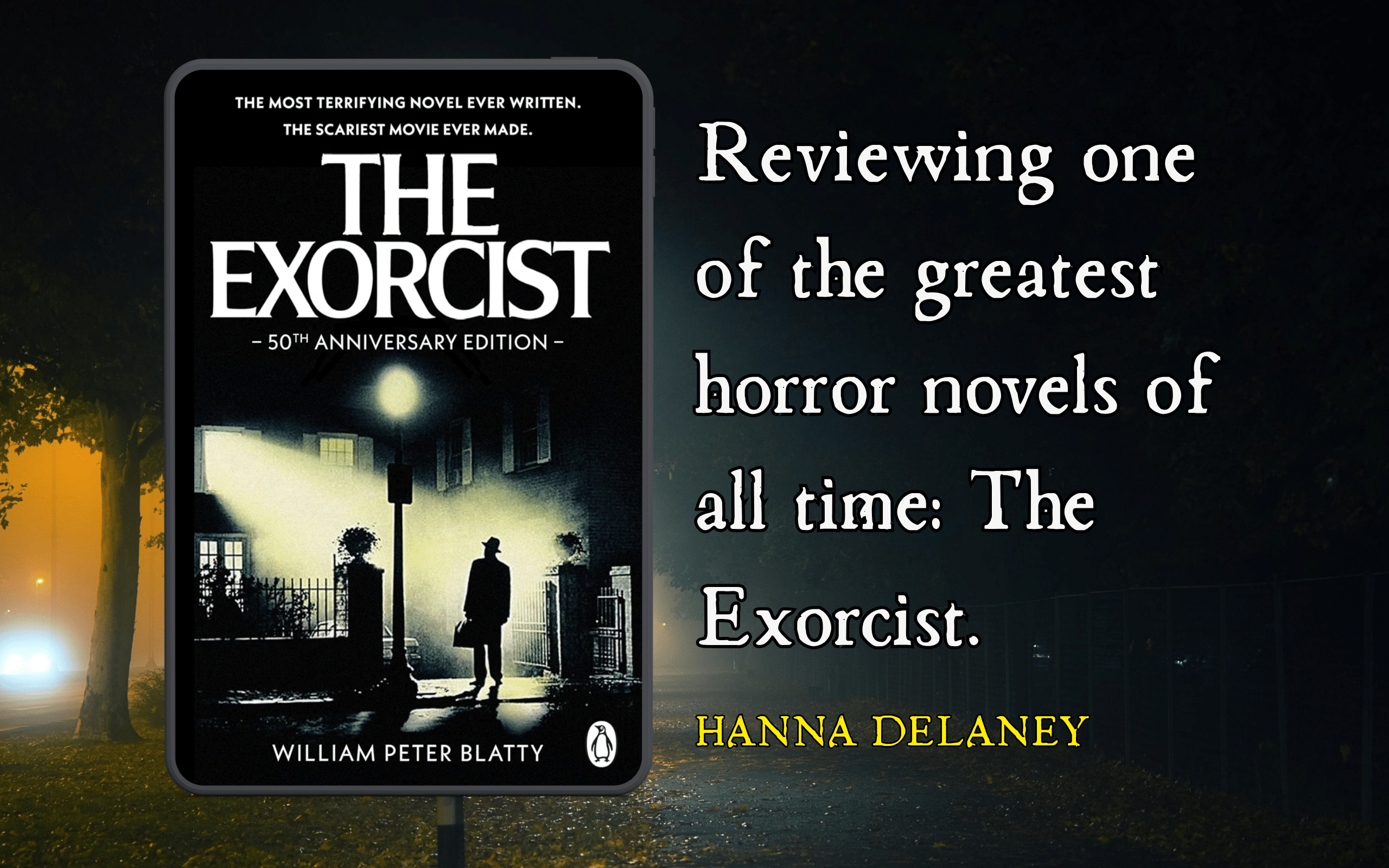
If you are reading this, the chances are that you have at least heard of The Exorcist. It was made into a film not long after its release in the early 1970s, and critics have called it ‘The most terrifying book ever written’. People aren’t so quick to agree with that today as we have plenty of news headlines to scroll through on our phones now. However in the 1970s at the height of Satanic panic in America and fear of bands like Black Sabbath, we can really appreciate what The Exorcist was offering.
I first read The Exorcist in 2025. I hadn’t seen the film yet (and I called myself a horror fan, huh?) but it was something I’d always meant to get around to. Reader, this book changed my life. I was raised Catholic and have always enjoyed religious horror as a sub-genre, but I hadn’t yet taken the plunge with this book.
Quiet beginnings, as it is with all the best horror.
The novel starts with actress Chris MacNeil being offered a dream role for a new film: she’ll be directing it. She lives in Georgetown, Washington D.C. with her eleven year old daughter Regan. Straight away we know Chris is divorced and it is implied that her husband left her when her career took off, so it’s just her and Regan with their two housekeepers and Chris’ PA, Sharon.
Blatty pulled me in immediately with this setup as Chris is sweet, carefree and loves her daughter. She wants the best life for them, and has to really think about it when she’s offered a directing job. She’s a single mother, so whatever she does has to also work with Regan. Her daughter is also sweet and spends her time in the basement craft/games room making sculptures and painting things. She makes lovely handmade things for her mum. It’s all very sweet.
And then there is a shift in atmosphere. It starts with a bad smell, then there’s scratching in the walls, furniture starts moving, and Regan begins to have trouble sleeping.
It was all very subtle until there’s a party downstairs and Regan randomly appears, telling people they’re going to die while she urinates on the carpet. It is shocking and horrifying at this point, as the child we’re seeing standing there can’t possibly be the same kid as the one making cute sculptures for her mum.
One of the most gripping aspects of this story was the desperation. Chris is desperate to get her daughter some help. There was a strong sense that there was a time limit, and they were running out. Regan isn’t sleeping or eating properly, she’s constantly wetting or soiling the bed. You don’t have to believe in demons to see that this is horrific and traumatising for the people in Regan’s life. This is even before the self-harm begins.
‘I don’t know why he does it! He was my friend before!’
I thought the introduction to the demon in part one was so insidious: Regan plays with a Ouija board in her craft room, and tells her mum she has a friend called Captain Howdy who is ‘very nice’ to her, but is nowhere to be found when her mother also uses the Ouija board.
But it can’t be demons! Surely not in this age of reason, in this modernised world.
Blatty offers us other explanations first. Chris takes Regan to see doctors, who are eager to help but they don’t know what’s going on. She’s not responding to anything other than being tranquilised. This isn’t a solution, and their concern is growing.
‘the results were negative as well. Klein frowned. He couldn’t understand it. He repeated the procedure.
And found no change.’
Blatty prepares us for the reality of demonic possession by eliminating other possibilities first. He wants to remind the reader that yes, this is a contemporary setting where you don’t have to be God-fearing and devout to live a good life and function as part of a society. He does not ridicule or belittle the doctors and their methods. This, to me, makes the possibility of possession even more terrifying because:
What do we do now?
We can’t medicate it away, we can’t talk it through in therapy. A brain scan or dietary change is not going to solve this problem. Blatty brings us to a new fear: the unknown.
Sure, there is plenty of scripture and essays on demons and possession, but does that mean we would all know what to do if someone we knew became possessed? I’m guessing not, because in the contemporary setting of The Exorcist, the characters would not (and why would they be?) be clued up on this. Even the priests are not 100% convinced that exorcism and witchcraft are a thing. Detective Kinderman discovers as much when he tries to probe Father Karras about it.
Blatty shows us that all other options have been exhausted, and the characters are losing hope.
I think what was really touching about this story was how so many people wanted to save this kid. Not because of any particular religious beliefs or personal agendas… just because it was the right thing to do. The world may be horrible, but there are always people trying to help, somewhere. Sharon, Willie and more touchingly, Karl, stand vigil over Regan while her mother tries not to lose her mind.
The theme of guilt throughout The Exorcist.
Guilt is a huge theme in The Exorcist and Chris is full of it. She’s a single mother in the 70s, and the Captain Howdy conversation brings her situation to the front of her mind:
‘Oh, what now? she fretted. Some unconscious hostility? She blames me for losing her father? I mean. what?’
Regan having an imaginary playmate is all the more worrying because Chris feels guilty for their situation. She worries that Regan blames her for the divorce, or the fact that her father never calls her, not even on her birthday. Chris reflects on a combination of things to feel guilty about, including struggling to find a playmate for Regan.
Like most mothers would, she blames herself for her daughter’s desire to invent a playmate because the poor kid is bored and lonely. Regan, who turns twelve int he book, is too young to process or talk about these things, so Chris has to fill in the blanks herself, some of the answers not always the most logical ones.
‘Chris was aware that the fantasy playmate was morbid and unhealthy.’
Father Karras is also plagued with guilt. He’s his mother’s only son, and as he’s an ordained priest, he is far away from home, going wherever his order sends him. The demon knows how he feels, and enjoys tormenting him with his own mother’s voice:
‘Why you do dis to me, Dimmy?’
She died alone. The mass ‘had been as lonely as her life’ and Karras, though he followed his calling, is plagued with regret at not becoming a civilian doctor instead, buying her a nice house and being able to spend his free time with her. This causes a huge crisis of faith for the priest which will not be resolved until he faces the demon.
Reviewing this book when it’s such a foundational work of horror fiction.
It’s difficult to review this book without thinking of all the horror books and films that have come since, but I’ll try. Looking at it with a 1970s lens, this was an ambitious, heart-wrenching novel that poses the what would you do? question and then some. This book is about resilience as much as it is about faith and fear. Chris can’t even get in touch with her loser husband to tell him that Regan is sick and is in and out of the psychiatric hospital for tests. She can only rely on herself and the small group of people around her.
At this point in time, atheism was on the rise in the western world, and as though two world wars didn’t do enough damage, other conflicts like the Vietnam War and ever-present anxiety over The Cold War really had people searching for answers, deep truths and reassurance, and not always finding any. Punk music was on the rise, and metal bands like Black Sabbath shocked audiences with their dark themes and perceived hostility towards the establishment. To add to the horrors, we also had the Manson Family murders and this would be the decade people learned about Ted Bundy, Peter Sutcliffe, The Hillside Strangler and John Wayne Gacy: quiet or well-to-do men who were monsters in the shadows, and this is just some of them.
The world as people wanted to know it didn’t exist any more.
The Exorcist is a story about faith, fear and having to navigate a world that is far from the one you hoped to live in.
What I got from this book is that it is about so much more than faith and believing in demons. Good religious horror is about fear and putting your faith in what’s left: that could be people, that could be medical breakthroughs, yourself, or of course, something greater than you.
This book was disturbing, breathtaking in parts and such a deep, layered story. I will not only recommend this but I’ll be reading it again and again.
This may no longer be considered the scariest book out there, but when we consider the impact it had in the time that it was written and first read, it’s a horror masterpiece.
Further Reading:
‘Come into me!’: Possession, Consent and Courage in The Exorcist.

Hanna Delaney is horror author from Liverpool. She is the creator of occult detective Daniel Muldoon, and is known for her Muldoon supernatural thriller series of Gothic mysteries set in 1890s Liverpool. Her latest book, Salome, is a Gothic religious horror novel about a Benedictine novice who becomes a vampire slayer in 1880s Liverpool.
Leave a Reply