As part of my series of author interviews, I’m showing you new modern fantasy books to read as well as new science fiction and horror from lesser-known but brilliant authors.
Ian Barr is a speculative fiction author from Canada and he’s the author of the upcoming fantasy series The Bloodless Affairs. It was great to catch up with him recently about his modern fantasy novel Synthetic Magic as well as his short fiction and the inspiration behind what he writes.
If you enjoy modern fantasy books with complex characters, stories told with multiple perspectives and elements of steampunk, mythology and old magic, you’re going to enjoy Synthetic Magic.
Interview with author Ian Barr about his new modern fantasy books: The Bloodless Affairs series, his work on The Midnight Vault II and the inspiration behind his work.
I recently read your modern fantasy novel Synthetic Magic and enjoyed it. There is so much to this book so I’ll need you to help me out here: What inspired you to write it?
Oh boy. This is not a question with a simple answer. Allow me to harken back to 2017/2018, when I first started writing Synthetic Magic… though the Bloodless world is older than that and actually had two other scrapped novels penned before SM came into being.
In the simplest terms, the inspiration for Synthetic Magic started with something small. In this case, it was a quote from science fiction author Arthur C. Clarke’s Three Laws, specifically the third and most widely known law: “any sufficiently advanced technology is indistinguishable from magic”. I started tinkering with the idea of a fantasy world that was advancing technologically and where the old magics had begun to stagnate and fade into something that fell under superstition or stigma. The implications of that closing gap between magic and science really intrigued me, especially how those two forces butting heads would impact a larger world. Synthetic Magic started from there, and definitely snowballed.
“any sufficiently advanced technology is indistinguishable from magic”- Arthur C Clarke
I loved the worlds in Synthetic Magic and it made me reflect on worldbuilding in general and how many SFF authors get it horribly wrong.
As you know, there’s a fine balance between establishing the world of the story and telling the story: what would your advice be to new SFF authors about this?
Best advice for SFF writers is a bit of hard truth: no one cares more about your world than you do.
SFF writers are worldbuilding powerhouses by nature. Designing a world that stands apart from real life while at the same time ensuring that it remains relatable, consistent, and logical is hard. Because of this, we tend to look at every little angle and have every little detail scribbled away in the dark corners of our notes. And that’s a good thing!
You should know the depth and lore of your world deeper than anyone else. But that doesn’t mean your readers will need to know or even care about all the nitty gritty details.
Whenever you’re dolling out any worldbuilding to help set a scene, establish a precedent, or whatever else your goal is with giving out information, it’s more important to know what not to say. Overexplaining how you made something work is only fun for you. Leave space for whimsy, intrigue, and mystery in your world. Readers love to speculate and theorize, so let them.
no one cares more about your world than you do.- Ian Barr
Octavian is my favourite character in Synthetic Magic with Georgia coming a close second. What is your naming process for characters?
Hanna, you are the first person ever to tell me that Octavian was their favourite. I’m curious as to why they is because he’s just such a dick…
The naming process for all the characters within this world follows an outline of sorts that I made during the worldbuilding phase. During the narrative, I never really go into why some have classical names while others feel more modern, but I would be lying if I said it wasn’t by design (part of that duality of old vs. new that I was speaking about in question 1). In terms of Octavian and Georgia, let’s take a look at their full names.
Octavian Baldoff Fortunato. Jeez, what a mouthful. Octavian comes from the Nazaryan society which I built and framed as the “Old World”. They’re stuffy and traditionalist, conservative and entirely rooted down in their cultural identities. With those kinds of national ties often comes the need to show your allegiance to the antiquity of your bloodlines and you end up with… names upon names. Octavian isn’t alone in that, if you consider other Nazaryan characters that make an appearance; Breyasus Zynik Melzama, Vittoria Florence Baldoff DeVir, and Tibor Augustine Constantius Abdiel Baldoff III… to name a few. You also might’ve picked up on the fact that the Nazaryan culture has a Greco-Roman vibe with a twist of Germanic influence. They’re a conquering society so a lot of the naming I did for the older families are riffs on ancient empirical names.
As for Georgia Blackwood, she’s from an entirely different society. There is a term I used in the book a couple times about people from the Starfall Islands and that is “Starfallen Mutts”. This society is much younger, innovators and traders from a thousand different lineages. Anyone could be from one of the Starfall Islands! As such, Georgia wound up with a much more generic and modern feeling name. Truth be told, ‘Georgia’ was a placeholder I was using as the character was partially modeled off a high school friend of mine, but once I got to the end of the book I settled on that just being the character’s name.
What do you wish you’d known about publishing a novel before doing exactly that?
Marketing is the worst. Especially if you don’t have any sort of plan. Think up something and do your research because shouting into the void does not work.
Additionally, there are a lot of hidden costs to being an indie author that I was not expecting. The obvious ones like editing services and cover art aren’t what I’m talking about, it’s everything else. Canadians are blessed to have access to free ISBN numbers, but the cost for author copies, service fees on publishers like IngramSpark, any paid ads, consignment fees, freight, and marketing materials really add up. I remember running a giveaway on Twitter in my first year as an author and the winner lived in Estonia. That was a fun postage bill to pay.
The good news is that a lot of this you can write off as business expenses at tax time (at least in Canada).
Can you tell us about where The Bloodless came from? What was your inspiration to write about this class of demigods?
Firstly, for those who haven’t read the book, the Bloodless are a militant order that are resistant to magical forces, coming from a closed-borders society within the world of Synthetic Magic. They’re sort of known throughout the world, but more in a boogieman sort of way wherein they’re loosely tied to legends of magic users and they stand against the perceived threat magic poses to society. A lot of clandestine operations, given that they look more or less like regular people. Returning to the question, I suppose I will say that the Bloodless aren’t demigods, per se. At least, not in the way that other characters in Synthetic Magic are. They are enhanced individuals, altered from their mortal forms, but they aren’t divine in the traditional sense.
The inspiration for them… It’s difficult to gauge how much to say without saying too much on that matter, as the series is still in the early days of what I have planned and I don’t want to give anything away by talking about where the idea of the order originated. Suffice to say that the idea of antimagic in the fantasy genre is not a new one, you can find it in a lot of different works. Mine just happens to be a variant of humanity that is resistant to magic. The Bloodless filled a need in the history of my world, created to combat a threat before their own strength turned the order into something more sinister.
They are enhanced individuals, altered from their mortal forms, but they aren’t divine in the traditional sense.
Who was your favourite character when writing Synthetic Magic?
This honour goes to Stiff, the crotchety old bosun serving aboard Slither. Originally penned as a means of comic relief, the old sailor turned into a delight for other reasons. There is so much information, speculation, and history I was able to subtly inject through the musings of an old man as he ambles his way through the story. Definitely my favourite.
Ian Barr talks about books that shaped him and inspired his fantasy and science fiction writing.
Can you remember the first book/book series you read back to back?
Magic Tree House! I was such a huge fan of these books when I was a kid. A quick Google search shows me that it continued on for years after I grew out of it, but who can forget such classics as Dinosaurs Before Dark, Mummies in the Morning, or Pirates Past Noon? I believe I followed Jack and Annie all the way through to Polar Bears Past Bedtime before I moved into other books and series like Wayside School or Harry Potter.
What real life inspiration is there behind your novel?
Definitely a menagerie of real life inspirations! Historical and mythological, obviously. You’ll find them if you’re looking for them. I have dipped into and taken inspiration from ancient Rome and Macedon, Mediterranean cultures, Scandinavian and Russian, Celtic and Druidic, and in bits that haven’t been released yet there are flavours of ancient Egyptian and Mesoamerican.
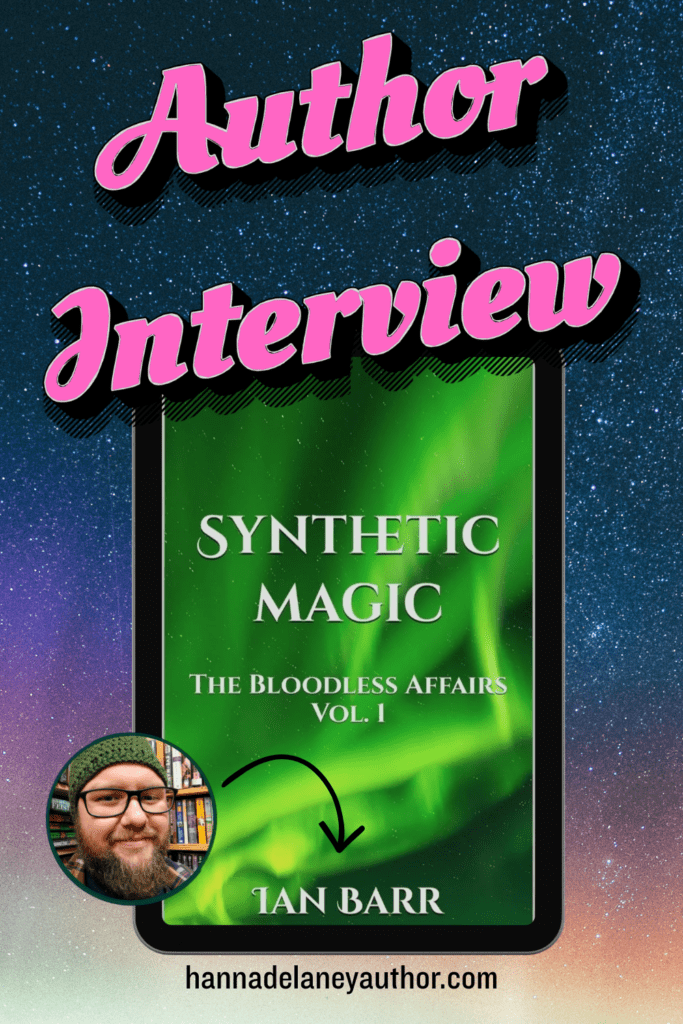
Synthetic Magic is the debut fantasy novel by Canadian author Ian Barr and serves as the first volume in The Bloodless Affairs series. The story is set in a world where ancient magic and advanced technology are integrated, centered on a mobile, ever-roaming school known as Academy.
What’s next in the pipeline for you and your fantasy/ science fiction?
Well, after the release of the second edition of Synthetic Magic, I kicked myself in the ass to work on the second Bloodless book. That’s in its infancy still but at least it’s actually happening. I’m a bit anxious to see how it’s going to go over. Some of the characters from the first novel aren’t going to be directly in the spotlight this time around as they grow into/find their place in a warring world and I’m curious to see if that will pan out how I want it to.
And of course, I am still working to get my novella Carnage off of Substack and into print. For those who haven’t heard about it, it’s a tale of love and lust in the wasteland about two star-crossed competitors participating in televised games of vehicular manslaughter. A lot of fun and available for free on my Substack until I finish prepping it for print.
Other works on Substack, I have a few Arkaen Origin short stories that are building into a larger LitRPG I’m working on (see: Whiskeyjack’s Shadow, Dream of Fire, and The Man Hunt). As well I have a few installments of Papa Whiskey 069 which takes place in the same dystopian world as Carnage but is the story of a seed ship readying to leave Earth to a settlement among the stars and the activities of the Earth First protestors who are plotting against it.
Beyond those, I have the start of another fantasy series written and currently in revisions. The novel is called Seventh Daughter and is my riff on a fairy tale kingdom and classic hero’s journey plot. I’m paying homage and taking inspiration to a truckload of public domain sources, with old favourites tossed in with my own signature madness. The story follows Marian Pendragon, daughter of Arthur, as she sets off on a journey to aid her ailing father just after he claimed the legendary sword Excalibur. Not ready to say much more on it just yet, but a lot of the “I hate retellings/reimaginings” crowd would absolutely hate it and that makes me unbelievably giddy.
Busy guy over here, and I just keep adding to my plate as I’m already thinking about 2027. I won’t confirm or deny anything yet, but indie authors should definitely keep me in mind for ‘27… If you catch my drift.
You recently wrote a short story for The Midnight Vault II event on Substack. Can you tell us a little bit about Alone Together?
How fun was MV2? Such a cool day and I was shitting myself as I threw Alone Together out there alongside so many strong contenders.
Alone Together is a story of a comfortable home in a protected community, about domestic partnerships and the lonesome gaps that appear within them. Following the couple James and Molly, it’s a look at the disheartening direction that companionship, intimacy, and human connection are potentially headed in a world where every perversion, temptation, and convenience are at our fingertips. Just because we’re together, doesn’t mean we’re not alone.
I’ve gotten reviews that it’s chilling, harrowing, disturbing, repulsive, delightful, too real, and a little too possible… Plus it’s also in the same world as Carnage and Papa Whiskey 069, so that was a fun connection too!
What’s your favourite film of all time?
Hanna, you’re making me really work on this one. How can anyone pick just one? Films like The Princess Bride and Labyrinth are iconic. Modern classics like Pirates of the Caribbean or Jurassic Park are easy picks. Animation? Beauty & The Beast, Wreck-It Ralph, or Heavy Metal are right there for me. Can’t forget the musicals; Seven Brides for Seven Brothers and Repo: the Genetic Opera leap to mind. Do I go to the based on true events stories such as A League of Their Own? Sci-Fi stars with The Matrix? What about comic book stuff like Watchmen or Hellboy? Or do I just go super obvious and pick The Return of the King?
Unfortunately it’s none of these. I’m going to pick one that terrified me as a child but I grew to love and have seen it 8 million times now. Have to go with the greatest sequel in movie franchise history: The Empire Strikes Back. Flawless.
If you’re looking for more modern fantasy and science fiction recommendations, Ian also has a section of his Substack devoted to his book reviews.
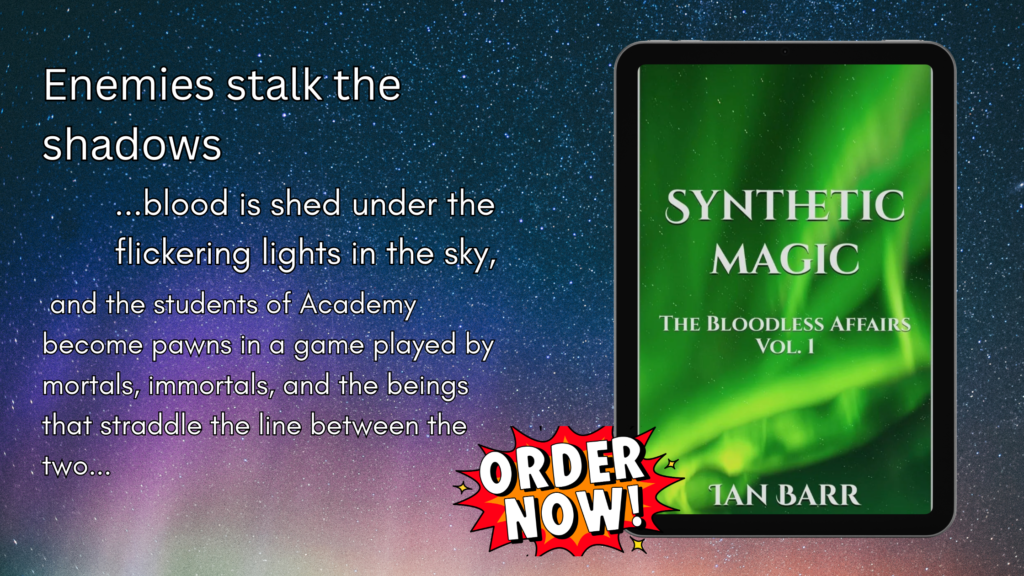
Ian’s debut fantasy novel Synthetic Magic is available now. Click the image to go to the book’s page.
Leave a Reply